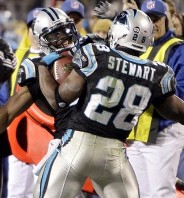
If Cam Newton's value in $ alone was so high, why go back to school at all? Why not play in Canada, arena league, somewhere else, where teams can bid freely for his abilities? The answer is because it isn't the best economic decision. Guys that are taking $ under the table are getting their cake and eating it too. They need the platform college football provides as much as college football needs them--the athlete probably needs it more actually. They're violating the rules of their workplace, and if they're caught they should be punished. When you enter college sports you're making the conscious decision that you are forfeiting certain benefits in exchange for others. It's an implicit contract. Don't play by the rules of the organization--you pay. Nobody forces them to do it, they have alternative options. Again if you read my last paragraph, my argument isn't that players are not under-compensated per their contribution; just that those circumstances are not unique to college sports and these athletes are not slaves, they have alternative options, and they are receiving benefits and compensation (on which we agree).Boom wrote:No one is denying that there are benefits for being a college athlete.Elduderino wrote:You're looking too narrowly at the benefits the exceptional players are receiving. Looking purely at the value of the academic scholarships I would agree that the "star" players aren't receiving a proportionally fair market value. The free education, however, isn't the end of their compensation.Handsome Dan wrote:That is what I understood your argument to be. It's unequivocal economic fact that some NCAA football players are worth more than the value of their scholarships. Whether or not they ought to receive this compensation, given their status as students and the historical nature of college athletics, is an entirely different debate.L Perry wrote:The argument was for further compensation over and above a full ride. Do not put words in my mouth! Context.Handsome Dan wrote:Perry, I think you are letting your idealism overtake your rationality. Believing they don't deserve to be paid is being idealistic and perfectly acceptable, but thinking they aren't worth anything is being naive.
Title IX innit?USUaggieDuck wrote:
the 11th best player on the women's basketball team takes offense to this. She deserves DOUBLE 160k.
Their affiliation with schools can provide them (this varies depending on the school they choose to attend) massive amounts of exposure. College sports and their media contracts provide a platform that is professionally unparalled; one where they can market their abilities to potential employers (and endorsement opportunities) every Saturday in the Fall. They receive free instruction and coaching from some of the best in their field. Not to mention, treatment and physical training in state of the art facilities, with state of the art equipment. I understand these benefits are difficult to monetize, but I'd argue that their value to a future professional career augments that $40K educational compensation quite a bit.
On a different plane, I'm also not sure the disproportionality in compensation for the "star" players vs. what they contribute is unique to college sports/athletes. That phenomenon is quite prevalent in many industries; hell I'm probably in one myself. I think it is interesting to watch people get up in arms about the exploitation of the college athlete, while ignoring the parallels to a variety of industries throughout our economy. Quite frankly, college athletes are college athletes because it is the most rational economic decision for them to make. They receive the value of a free education for when sport is no longer a viable career option (and we all know that is an inevitability), and they receive publicity and marketing of their skills at a value they cannot achieve elsewhere. If it made more sense to be compensated in real dollars, they'd be playing football in Canada or in any sort of alternative "minor league" that would have undoubtedly been sustained by now.
But it's pretty simple
If you remove the "amateurism" tag and allow these players to negotiate either through a collective bargaining agreement or through an agent... You would see an increase in compensation.
If Cam Newton could get 180k under the table. How much do you think he could command if multiple schools could bid freely for his services?
The argument for paying players is, at its core, an emotional one. It's about the image that the player is being exploited. Would there be bidding on superstar players if you removed "amateurism" from College Sports? Of course! The NFL, CFL, AFL, etc.. are functional examples of just that.
But the association of Colleges and Universities that formed the governing body of college sports chooses not to do so (in RE: to removing the amateur tag). It is the NCAA's prerogative to operate as they see fit. If the athlete doesn't want to participate under those guidelines, they are free to pursue other options.
Edit: To clarify, the overriding point I'm trying to make is the argument that college athletes should be paid is erroneous--not that a very select few exceptional college athletes are not undervalued per their economic contribution.

 The "amateurism" tag will never be removed!